What is AromaYoga®?
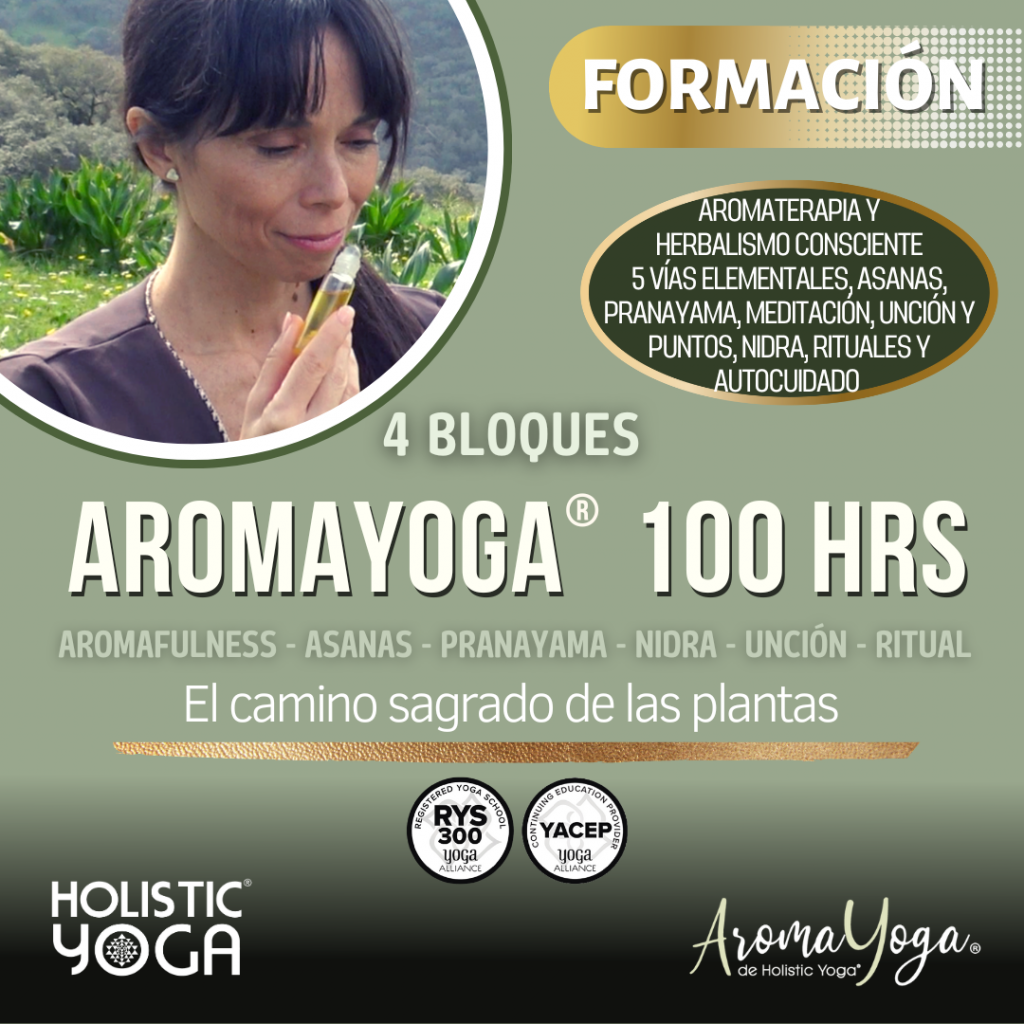
Aroma Yoga® by Holistic Yoga® It is a method that promotes the state of «Yoga» through the appropriate and safe use of aromatic herbal extracts, which facilitate a sacred connection via yogic practices (asanas, meditation, pranayama, nidra, mudras) and healthy habits (aromatic self-care).
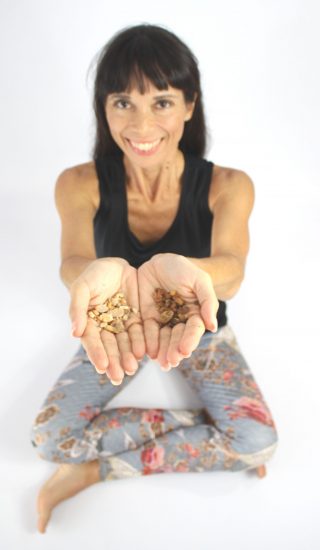
The herbal substances used by AromaYoga® include vegetable oils, essential oils, hydrolates, resins, dried herbs and other natural substances, which, through smell and touch, help us to influence our emotional system and bring about a shift in consciousness.
Since ancient times, the practice of yoga has been associated with certain scents (incense, herbs, etc.) that promote a state of meditation, cleansing and purity, and so on. These days, we have access to a wide range of natural substances from the plant kingdom that can make your practice a wonderful experience
Introduction to the AromaYoga® HY Training Course. Find out about our approach
Video: “The Plant Kingdom and the Sense of Smell: Emotion, Memory and Spirituality”
What will you learn on this course?
– Fundamentals of Herbalism and Aromatherapy (principles, methods of application, etc.)
– The emotional, mental and spiritual dimensions of aromatherapy. 40 essential oils, as well as other aromatic substances (hydrolates, resins), vegetable oils, waxes, etc. You’ll also learn the basics of plant communication so you can draw on your intuition.
– Production of plant-based preparations as part of the course FITO-LAB to interact with, touch and experience the Plant Kingdom as part of the alchemical process: collecting plants, drying them, making macerates, alcohol extracts, scented sprays, preparations with essential oils in dropper bottles and roll-ons, balms, hydrosol gels, floral water, energised flower waters, bouquets for incense, etc.
– 3 Fundamental Principles on Spirituality and the 4 Elements in the practice of yoga, self-care, the cycle of the seasons and personal growth
– You’ll discover the The neuroscience of smell and its influence on emotions, memory, cognition and sense of self.
– You’ll learn PRELIMINARY EXERCISES which trigger the ventral branch of the vagus nerve and in this way, prepare yourself for mindful smelling through techniques such as: preparatory postures, body awareness, grounding, heartfulness, etc.
– You’ll learn how to perceive the subtle effect of aromas on your psyche through our meditation technique: AROMAFULNESS.
– You’ll learn how to incorporate the power of “affirmations” and conscious intention into the use of aromatherapy, both in your daily life and during yoga sessions, through AROMASANKALPA
– You will foster personal self-care by incorporating routines that connect you to the sacred through the AROMARITUAL which teaches you how to set up an altar, perform energy cleansing, cleanse your yoga mat, or take a sacred bath or shower.
– You will work with your body mindfully through the practices of AROMASOMA which, on the one hand, prepare you to experience the effects of an aromatic substance on your body and, on the other hand, teach you to practise mindful smelling whilst performing Yin Asanas (AromaYin) or Vinyasa (AromaNamaskar).
– You will combine the use of mindful breathing with AROMAPRANA as a means of altering emotions and memories through specific pranayamas
– AROMAMUDRA It will teach you the power of conscious anointing and the use of mudras (energetic gestures), both on their own and in sequences.
– You’ll learn about some acupuncture points that are easy to stimulate to help improve certain emotional and mental conditions through ACUAROMA
– You’ll learn how to lead sessions on AROMAYOGA NIDRA based on conventional Yoga Nidra techniques, incorporating mindful smelling and visualisations that connect with the plant kingdom.
– You’ll learn how to use all these tools SEQUENCED for group classes or AromaYoga® workshops on specific topics.
– You will become a Facilitator for TAILOR-MADE SESSIONS and learning to direct the SNIFFING TRAINING AromaYoga®

Who is this training course for?
- Yoga teachers who wish to specialise in yoga and aromatherapy
- Yoga practitioners interested in learning how to incorporate the sacred path of plants into their yoga practice
- Therapists working in the field of aromatherapy (naturopaths, aromatherapists, practitioners of shamanism, etc.) who wish to broaden their knowledge and learn how to apply it within the context of yoga.
- Teachers, yoga practitioners and, in fact, anyone seeking a connection with the plant kingdom, wishing to learn more about it and about the spiritual pathways to connection offered by AromaYoga®
Module 1. AromaYoga® Fundamentals – 20 hours
PROGRAMME FOR BLOCK 1
BLOCK 1: Fundamentals of Aromatherapy and Preparatory Exercises
-
What is AromaYoga®?
-
The Philosophical Influence of Yoga
-
Other influences from Japan, Ayurveda and Native American herbalism
-
Ethical principles
-
Applications (Self-care, Groups and Staff)
-
Herbal substances used in AromaYoga® HY
-
Aromatherapy I – History
-
Aromatherapy 2 – Basic Concepts
-
Aromatherapy 3 – Extraction Methods
-
Aromatherapy 4 – Functional groups and families
-
Aromatherapy 5 – Methods of application
-
Aromatherapy 6 – Contraindications and precautions
-
8 Essential oils
-
3 Hydrolates
-
Sacred space and altar
-
Tuning of the nervous system
-
Preparatory work experience
-
Olfactory Awakening
Block 2. Herbal Substances and Pathways of Connection – 30 hours
PROGRAMME FOR BLOCK 2
-
PLANTS AND SPIRITUALITY
-
Herbalism and the spiritual uses of plants
-
Plant Intelligence and Communication
-
The 3 Universal Principles
-
5 Elements in Nature
-
The Essential Oils Tree
-
Connections to plants according to the Elements
-
PHYSIOLOGY OF SMELL
-
Essential oils and aromatic alcohols
-
Anatomy of the Sense of Smell
-
The neuroscience of smell
-
Aromatherapy, Emotions, Memory and Cognition
-
ESSENTIAL OILS
-
A.e. ROOTS
-
A.e. MADERAS
-
A.e. RESINS
-
A.e. PLANT LEAVES
-
A.e. TREE LEAVES
-
A.e. FLORES
-
A.e. FRUIT
-
A.e. SEEDS
-
FITO-LAB and METHODS OF APPLICATION
-
AIRE Fito-Lab (essential oils and scented alcohols)
-
AIR Application (diffusers, sprays, inhalation)
-
FUEGO Fito-Lab (bunches and resins)
-
FIRE Application (incense)
-
AGUA Fito – Lab (Flower waters, Hydrolates, Gels)
-
WATER Application (spray, rubbing in)
-
TIERRA Fito – Lab (Aromatic vegetable oils, Infusions, Balms)
-
EARTH Application (sacred anointing and energetic gestures)
Module 3. AromaYoga® Practice and Teaching – 40 hours
BLOCK 3 PROGRAMME
-
AROMAFULNESS – Mindful Smelling
-
Mindfulness: Origins and Neurobiology
-
What is AromaFulness? Principles and Objectives
-
The practice of Aromafulness
-
Aromafulness “flow”
-
Cognition. The language of smell
-
Emotions. The sense of smell
-
Memory. Olfactory memories
-
Aromatic circles
-
AROMASANKALPA – Affirmations
-
What is AromaSankalpa?
-
Scope of Application
-
Sankalpas for essential oils
-
AROMARITUAL – Spiritual connection
-
What is AromaRitual?
-
Scope of Application
-
Mat cleaning
-
Sacred Bath or Shower
-
Energetic cleansing (personal and of a place)
-
Create my “AromaRitual”
-
AROMASOMA – Asanas and Olfactory Somatics
-
What is AromaSoma?
-
AromaSomatic
-
AromaYin
-
AROMAPRANA – Aromatic Breathing
-
What is AromaPrana?
-
Aromatic Jala Neti
-
Aromatherapy Breathing Exercises
-
Pratimarsha and Dhoom nasya
-
AROMAMUDRA – Aromatic anointing and gestures
-
What is AromaMudra?
-
Conscious anointing
-
AM1 Mudras (single)
-
AM2 Mudras (simple dynamic ones)
-
Mudras AM3 (Dynamic Pro)
-
ACUAROMA – Aromatic energy points
-
What is AcuAroma?
-
The Basics of Acupressure
-
AYHY’s AcuAroma Methodology
-
Regulatory points (n.e.c.) – AYSNA protocols
-
Olfactory points – AYO Protocol
-
Points for Emotions – AYE Protocols
-
Celestial Window Points – AYVCE Protocol
-
AROMAYOGA NIDRA – Aromatic Sleep
-
What is AromaYoga Nidra?
-
Stages
-
Other approaches related to relaxation / meditation
-
Addition of flavourings
-
Examples
-
AROMAYOGA® HY CLASSES AND WORKSHOPS
-
AromaYoga® HY Course
-
Aromatic Spaces and Moments
-
Tool sequencing
-
Examples of lessons
Block 4: The personal approach – 10 hours
BLOCK 4 PROGRAMME
-
THERAPEUTIC AROMAYOGA
-
What is Therapeutic AromaYoga?
-
Target groups (Psychology and Olfactory Disorders)
-
Stress, Emotions and Trauma
-
Neuroplasticity
-
The role of aromatherapy in the psyche
-
The Mind in Yoga
-
Polyvagal Theory and the Margin of Tolerance
-
Areas of Wellbeing. Holistic Living
-
Ikigai: A Life with Purpose
-
Therapeutic tools
-
Tailored strategies
-
AromaYoga® HY Olfactory Training
-
Olfactory disorders. Types and causes
-
Cooperation with other professionals
-
Support and supervision
Once the course has been completed and the assessment tests have been passed, Yoga Kula® will issue:
- OPTION 1. CERTIFICATE OF ATTENDANCE valid for personal practice if no it is yoga teacher)
- OPTION 2. YACEP DIPLOMA, with the number of hours corresponding to the modules completed for yoga teachers. This diploma is valid for submission towards official yoga professional certification schemes (Spain). Furthermore, if you are a yoga teacher registered with Yoga Alliance, you can use the hours from this course towards your YACEP credits
- OPTION 4. RYT300 CERTIFICATE (Yoga Alliance). Upon completion of the training modules that make up HOLISTIC YOGA® 300 HRS (www.holisticyoga.com.es) you can obtain a Yoga Alliance certificate which allows you to register with that association as RYT200 (if you’re not already a teacher) or as RYT500 (for teachers already registered as RYT200). To obtain this diploma, you must attend the majority of the course hours, whether the course is delivered face-to-face or via live online sessions.
LIVE ONLINE FORMAT. Attending the seminars via Zoom
*** Unlimited access to pre-recorded material ONLINE (ON-DEMAND) once the videos have been edited and uploaded to the course
AromaYoga® is a registered trademark in Spain; therefore, neither its name nor its logo may be used unless a trademark licence agreement has been signed. This agreement may be signed upon completion of the training course and permits the teacher to use the trademark solely for classes and workshops (not for training purposes).
Furthermore, the material provided is protected by copyright; all rights are therefore reserved. The total or partial reproduction of this work (including text excerpts and images), its incorporation into a computer system, or its transmission in any form or by any means (electronic, mechanical, photocopying, recording or otherwise) is not permitted without the prior written authorisation of the copyright holders. Infringement of these rights may constitute an offence against intellectual property.
Why have we registered a trademark and copyright for the material? After several years spent on training, we have had a number of experiences that have led us to “protect” the many years of work, effort and dedication required to create original training programmes, as there are people who do not respect intellectual property or the efforts of others.
Thank you for your understanding.
This course has been created and is led by Helena Chacón.
Helena was introduced to yoga as a child and began practising regularly in 1999. She has been a teacher since 2006 and, together with her husband Javier Muriel, runs the Yoga Kula School, which is registered with the Yoga Alliance (RYS200 and RSY300). She is an experienced yoga teacher (E-RYT500/YACEP) with official certification in Spain. The styles that have most influenced her practice and teaching are Vinyasa, Iyengar, Anusara, Ashtanga Vinyasa, Rocket, AcroYoga (Acrovinyasa style), Yin Yoga (Paul Grilley’s functional approach), Yoga Nidra, etc.
Alongside her work in yoga, Helena has trained in a wide range of natural and holistic therapies. She was introduced to aromatherapy in 2007 whilst studying chiromassage, and since then essential oils have been an integral part of her therapeutic and personal practice. She has completed several courses in natural cosmetics and aromatherapy (Holistic Aromatherapy, Emotional Aromatherapy, Sacred Aromatherapy, Aromatherapy and TCM, Introduction to Aromachemistry), as well as training in other therapies such as TCM, Ayurveda, Crystal Therapy, Bach Flower Remedies, Reiki, etc.
If you’d like to find out more, we invite you to visit their website www.helenachacon.com
HOLISTIC YOGA® 300 HRS
Advanced Holistic Yoga Programme (Nature, East and West)
AromaYoga® 100 hrs is one of the training courses that make up Holistic Yoga®. You choose your programme by adding up the hours to reach a total of 300 hrs, choosing from TCMYoga® 100 hrs, AyurYoga® 100 hrs, Myofascial Yoga® 100 hrs, Pranayam® 50 hrs, Crystal Yoga® 50 hrs and Aroma Yoga® 50 hrs
www.holisticyoga.com.es
E-LEARNING PLATFORM
AromaYoga® is hosted by "Holística Formación"
AromaYoga® 100 hrs is hosted on a robust and well-established online training platform. Once you have enrolled, you will have unlimited access to all written and audiovisual material; you will be able to ask questions on the support forum or via email, and complete the assessments.
www.holisticaformacion.com
KULA® YOGA SCHOOL
School registered with Yoga Alliance as RYS200 and RYS300
Yoga Kula® is a yoga training school offering a 200-hour yoga instructor training course, YACEP specialisation courses and a 300-hour advanced training course. Its trainers have extensive experience and training, hold official certification in Spain and have completed specialised courses in teaching (CAP, Trainer of Trainers).