WHAT IS BIOTENSILE STRENGTH?

WHAT IS BIOTENSILE STRENGTH?
 The motto of Myofascial Yoga® is “Keys to a biotensegrity body”
 But what exactly is a “BIOTENSEGRITIC BODY”?
 The first example that springs to mind when I talk about a “biotensegrity body” is that of a cheetah running across the savannah, completely “in tune” with its physical body.
 In Patanjali’s classical yoga, two qualities are defined as essential to the state of “asanas”. On the one hand, “Sthira” (stability, firmness) and, on the other, “Sukham” (kindness, gentleness). Interestingly, these two essential characteristics are precisely what define the concept of “biotensegrity”.” The term “biotensegrity” was coined by Dr Stephen Levin and means “the tensional integrity of a living organism” or “the tensegrity of an organism”. It refers to a self-supporting form that does not depend on external forces nor is it influenced by gravity. This idea actually stems from R.B. Fuller, an architect and engineer who described tensegrity as “a combination of forces existing within a structure formed by an infinite network of supporting elements (rigid elements) interconnected via tensile elements (elastic elements) that give the structure its overall integrity”. The popular geodesic domes are based on this idea of a self-supporting structure (note that they have no columns or pillars), as are the domes of some cathedrals or buildings such as the one shown in the photo.
In other words, the concept of biotensegrity refers to a body in which there is a balance between tension and compression, tension and space, elongation and compaction, release and control, and so on; that is to say, a body that is self-supporting and maintains its structural integrity whilst defying gravity without too much effort.
 This revolutionary concept in architecture applies perfectly to the fascial model, such that the bones are the rigid elements and the fasciae are the elastic ones. In other words, the concept of tensegrity applied to the human body means that it is supported by a series of tensions that are self-sustaining (integrity). We could say that our bones “float” (note that our bones do not touch one another) within a fascial matrix that connects and supports them. When a force acts on one area, the entire system absorbs the impact and adapts to it. In other words, all the elements of the system dissipate and distribute the force exerted upon it.
 This has been revolutionary for the fields of anatomy and fitness, which have traditionally focused on working specific, isolated muscles. Our body is a fully integrated system, so that when we exert force in one area, it affects distant parts of the body. Furthermore, according to Thomas Myer (2010), if the tensegrity structure’s tensile components (fascia) are stretched, the structure is able to withstand a greater load without deforming. Fasciae are the tissue through which muscles exert their action. If they are stretched and healthy, our muscles will be more efficient; in other words, we will be able to withstand greater loads of tension without expending excessive energy and without injury.
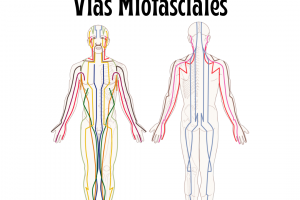
 In the practice of MYOFASCIAL YOGA®, we take an integrated, holistic and comprehensive approach to our fascial tissue. In each exercise, we will seek to achieve biotensegrity – that is, the body’s energy efficiency, whereby the forces exerted upon it are absorbed holistically rather than locally. The key lies in the balance between tension or force and elasticity. In other words, the forces applied must be dissipated through the continuity of the tissues, practising with the whole body as a single unit so that the entire tensional load is not borne by a single muscle, thereby allowing the body to maintain its integrity and self-support. In this way, we will work with muscle chains (myofascial pathways), focusing energy on specific pathways within the fascial tissue, whilst not forgetting that our body functions as a whole.
 The healthy “tension” we refer to in a biotensegrity structure enables our body to maintain a healthy posture, independent of gravity and with the least possible energy expenditure. In other words, more relaxed practices (Restorative, Yin, Yoga Nidra) should always be combined with practices that involve a certain degree of tension and tone (Sun Salutation) in the tissues. Otherwise, we will enter the realm of muscular and fascial laxity, losing our balance – just as we would if we were to practise only dynamic and strength-based exercises without allowing the body to recover and regenerate. At MYOFASCIAL YOGA® we use a method based on various types of exercises and yoga asanas, categorised into five pillars, which provide both “fascial tension and stretching” and “integrity and strength”, helping to sculpt your body and making you feel healthy and agile.
 TEXT taken from the MYOFASCIAL YOGA® TRAINING COURSE
Written by: Helena Chacón
 WOULD YOU LIKE TO TAKE THE 100-HOUR MYOFASCIAL YOGA® TRAINING COURSE?
 ONLINE FORMAT (Recorded + Live)
www.yogamiofascial.com