ACUPUNCTURE MERIDIANS vs MYER’S MYOFASCIAL MERIDIANS. THEIR INFLUENCE ON THE PRACTISE OF YOGA
WHAT ARE FASCIAS AND HOW DO THEY AFFECT YOGA?
ACUPUNCTURE MERIDIANS vs MYER’S MYOFASCIAL MERIDIANS.
Fascia is a connective tissue that extends throughout the body as a three-dimensional network from head to toe, from back to front and from the inside to the outside without interruption. It is made up of elastic fibres (which allow for movement), collagen fibres (which provide strength and stability) and a gel-like, fluid substance known as the extracellular matrix (which provides fluidity and hydration). It surrounds muscles, bones, nerves, blood vessels and organs. The “epimysium” surrounds the muscle, the “perimysium” surrounds groups of muscle fibres and the “endomysium” surrounds individual muscle fibres. All these layers join together and terminate in tendons or ligaments.
When this system malfunctions (for example, due to poor posture, inflammation, trauma, etc.), it can affect our health in many ways, giving rise to various symptoms that appear to be unrelated. […]
Functions of the Fascia:
• It provides support and structure to the body, promoting its integrity.
• It is involved in every movement and absorbs impacts.
• It aids blood circulation, particularly in the venous system and the lymphatic system.
• Changes in the fascia precede chronic congestion in any tissue.
• Fascia are responsible for inflammatory processes. The central nervous system is surrounded by fascia.
Furthermore, at a cellular level, the fascia plays an important role in protection, cellular respiration, nutrition, waste removal, metabolism, hydration, etc., so any dysfunction of the fascia can create an environment conducive to illness (poor cellular efficiency, necrosis, disease, pain, etc.).
MYER’S MYOFASCIAL MERIDIANS
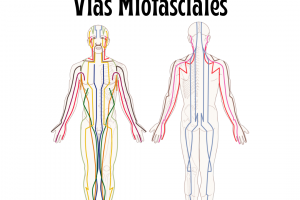
The famous “myofascial meridians” are lines of connective tissue that provide the structural forces required to perform movement, as they connect all parts of the body and give it integrity (tensegrity lines). This concept was introduced in 1997 by Thomas Myers in an article entitled “The Anatomy of the Trains”. According to Myers, he based his lines on the anatomical studies of Hermann Hoepke (1930), combined with his knowledge of Rolfing and cadaver dissection, which enabled him to examine these anatomical pathways with greater precision. Although Thomas Myers initially considered that the anatomical pathways bore a resemblance to acupuncture meridians, he believed that they were not entirely equivalent.
The discovery of myofascial pathways or muscle chains is of great clinical significance. Thanks to our understanding of these, musculoskeletal pain can be treated not only at the site of the pain but at any part or point of the fascia. This distal treatment of conditions is beginning to bear similarities to distal acupuncture treatments, in which areas of the body distant from those experiencing pain are needled.
FASCIAS AND YOGA
When we practise yoga, we will be more aware if we understand our body’s fascial system.
If the fascia loses moisture, it becomes stiff, dry and restricted; in this case, you should practise a very nourishing style of yoga such as Yin Yoga or Restorative Yoga. With well-hydrated fascia in perfect condition, we are more energy-efficient as our muscles will tire less easily.
On the other hand, practising sport promotes blood flow to the muscles, toning them and providing warmth and energy. In other words, sporting activities, unlike yoga, focus more on the cardiovascular system and the muscles and do not affect the fasciae. It would be considered a more ‘Yang’ practice than the former.
This means that, in general, sport does not affect our psyche to the same extent as yoga does, due to the significant link between the fascial system and the nervous system. When our body is under stress, there are two ways to release it. Either through the chemical release of neuropeptides, which alter our mood and affect various parts of the body; or through patterns of tension that persist over time, creating postural habits – these begin with alterations in the nervous system, then spread to the muscles and finally to the fascial system. This final stage means that the fasciae record and store our mental and emotional impressions as if they were a filing cabinet. This reminds us of the Sanskrit term “Samskaras”, which refers to the impressions that our mind records, shaping our beliefs, attitudes and personality. So, when we perform a sustained stretch (a yoga asana), we begin to change the connective tissue and, ultimately, our emotions and even our limiting beliefs. In short, the transformative power of yoga lies in the transformative power of the body’s fascia.
ACUPUNCTURE MERIDIANS AND TRACTS
Following on from Myer, Langevin, H.M. and J.A. (2002) demonstrated that the insertion and manipulation of acupuncture needles produce changes in cells that are transmitted via connective tissue or fascia. They consider that acupuncture meridians are equivalent to the anatomical planes of connective tissue. Later, in 2009, Peter Dorsher established that the remarkable correspondence between acupuncture meridians and myofascial lines is evidence that acupuncture meridians are represented by the fasciae of the human body. Peter Dorsher identified the following similarities:
Superficial Posterior Line → Bladder
Superficial Frontal Line → Stomach, (Spleen)
Deep Frontal Line → Kidney, (Liver)
Lateral Line → Gallbladder
Spiral Line (previous) → Stomach
Spiral Line (posterior) → Bladder
Deep Anterior Arm Line → Lung, (Large Intestine)
Superficial Anterior Line of the Arm → Pericardium (Heart)
Superficial Posterior Line of the Arm → San Jiao
Deep Posterior Arm Line → Small Intestine
Furthermore, within the anatomical pathways we find areas or points of pain which, in physiotherapy, have been known as “trigger points” since the mid-1800s. These are recognised as sensitive points formed by soft tissue, the pain in which is relieved through pressure, massage, stretching or dry needling. Dorsher analysed these points and likewise concluded that there is a striking correspondence between trigger points and acupuncture points. He concludes by stating that it is fair to recognise that current treatments for myofascial pain represent an independent rediscovery of the healing principles of traditional Chinese medicine.
HOLISTIC YOGA THERAPY / HOLISTIC YOGA / MYOFASCIAL YOGA