Yin Meridian Circles, Yang Flow and Yang Core
YIN CIRCLES, YANG FLOW AND YANG CORE
What they are, how I came to create them, and how you can practise them
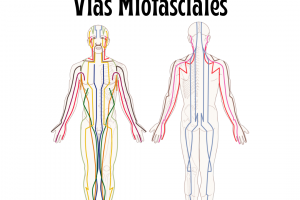
In a previous post I discussed how I became interested in the link between yoga and Chinese Energy Anatomy, and how I began to relate the Major Meridians to the myofascial pathways. In this article, I’ll be presenting the sequences I designed years ago to work on all the meridians, offering a holistic and energetic approach. If you’re not familiar with the Major Meridians, I’d advise you to have a look at the following article first: Yoga, Major Meridians and Myofascial Tracts
ORIGIN OF THE MERIDIAN CIRCLES
In 2009, whilst studying at the MTC School, I discovered what is known as THE CIRCADIAN CYCLE IN TCM. Chinese medicine describes in great detail a network of energy flow which it calls “Theory of Meridians“. Within this entire network, there is a group of 12 meridians, known as the Principal Meridians, which are responsible for carrying energy (Qi) and blood (Xue) to the tissues, organs, etc., so that you can maintain physiological and psychological “homeostasis” every day. These 12 meridians are intertwined in a “closed circuit”, so that energy circulates through them gradually until it has travelled through all of them in a 24-hour cycle. This means that your peak energy or vital force is predominantly in one meridian for 2 hours, then moves on to the next, and so on.
This fascinated me. I had read a book on circadian rhythms, and the explanation provided by TCM struck me as very specific and detailed. It made a lot of sense to me for several reasons. I had also been studying Ayurveda for some time, and this medical science emphasises daily self-care in accordance with the time of day. Likewise, I also noticed that some recommendations from traditional yoga, such as practising pranayama early in the morning, made sense. However, the times didn’t quite add up for me… The two-hour cycles seemed a bit “off” to me, not entirely in line with my own experience. Eventually, I found an explanation for this, which I’ll set out in more detail below. Let’s take it step by step…
When I began making notes on the link between yoga and TCM, I asked myself two questions
How can meridian-based yoga be used from a therapeutic perspective?
How can I practise a sequence of exercises that works on all the meridians as a form of self-care?
We will look at the answer to the first question in more detail below. As for the second question, I looked for information that combined yoga with meridians. At the time, there was nothing available in Spanish and almost nothing in English. I came across the work on “Meridian Yoga” by Daniel Orlansky and her “Energy Flow Circle”. I thought it was a wonderful piece of work, firstly because of its innovative nature and secondly because it integrated Asanas with the circadian cycle, but this circle did not answer my initial question: How could I offer circles that could be used by people with different tendencies and biotypes? What I was clear about was that I wanted to offer my clients sequences of both static and dynamic practices, suitable for all kinds of people. To meet this need, the YIN MERIDIAN CIRCLES, YANG FLOW and YANG CORE CIRCLES were created, which I present to you below.
The Yoga en Red magazine published part of this content, as well as the “Circle of Yin Meridians”, in October 2018, inspiring teachers and trainers with it
THE CIRCADIAN RHYTHM ACCORDING TO TCM
The 12 Main Meridians are interconnected, forming a closed circuit throughout the day and night, thereby supporting the body’s metabolic functions. Over the course of the 24-hour daily cycle, Qi flows along the meridians in a specific pattern. Every two hours, the flow of energy becomes more intense in a specific meridian, causing a peak in energy in the associated organ, which can either benefit or harm our health. If the organ to which the Main Meridian is linked via the internal branch is:
ENERGY DEFICIENCY – During the two-hour period each day when your energy levels peak, your health will improve as that organ receives extra energy and this is the time for it to recharge and regenerate.
EXCESS ENERGY – During the two hours of the day that belong to it, it will receive even more energy and will “overflow”, manifesting itself as some sort of imbalance.
For example, if we have low energy in the Heart, at midday – which is its peak time – we will feel more cheerful, happy and outgoing (aspects governed by this organ); in other words, we will feel more “lively”. Conversely, if our Heart is in excess, midday will be our most vulnerable time, when we are prone to heart attacks, anxiety, crises, tachycardia, etc.
Energy Flow Path
The flow of energy travels along the trunk and the limbs. It begins in the chest and moves to the hands; from the hands it goes to the head; from the head it descends to the feet; and from the feet it returns to the chest. This “loop” is repeated three times (4 × 3 = 12):
- From the chest, the Qi moves through the front of the arms to the hands.
These are the meridians Yin of the arms: Lung, Heart y Pericardium.
- Qi flows from the hands back to the chest along the backs of the arms, ending at the head.
These are the meridians Yang of the arms: Large Intestine, Small Intestine and San Jiao.
- Starting at the head, the Qi flows down the front, outside and back of the legs, ending at the feet.
These are the meridians Yang of the legs: Stomach, Bladder y Gallbladder.
- Starting from the feet, the Qi rises again, travelling along the inner sides of the legs to reach the chest
These are the meridians Yin of the legs: Spleen, Kidney and Liver.
The circadian cycle in TCM follows this sequence:
Lung (3 – 5 am) – Large Intestine (5 – 7 am) – Stomach (7 – 9 am) – Spleen (9 – 11 am) – Heart (11 – 1 pm) – Small Intestine (1.00 pm – 3.00 pm) – Bladder (3.00 pm – 5.00 pm) – Kidney (5.00 pm – 7.00 pm) – Pericardium (7.00 pm – 9.00 pm) – San Jiao (9 pm – 11 pm) – Gallbladder (11 pm – 1 am) – Liver (1 am – 3 am)
Time zone adjustment in Spain
As I mentioned earlier, I spent months – even years – observing that, whilst the sequence of energy flow made sense to me, the peak times for each organ did not. For example, the Large Intestine is at its peak between 5 and 7 am. This means that this period is the best time to have a bowel movement, but in my case, my best time was between 6 and 8 am, sometimes even a little later. Or, for example, I felt that the Bladder – an organ that governs Vital Energy and Impulse – was still active after 5.00 pm. This made me wonder whether perhaps the times weren’t entirely “correct”. Then I realised that all the books and articles clearly state that the hourly cycles are “SUN HOURS“. OF COURSE!!! In Spain, where I live, our clocks don’t follow solar time. At certain times of the year, there can be a difference of two hours – or even more if you’re further away from the centre of the peninsula. Due to its geographical location on the Iberian Peninsula, we should have a time zone similar to that of London, Morocco or the Canary Islands. In other words, one hour behind in winter and, in summer, due to daylight saving time, up to two hours behind.”.
How can this be? What is the reason for this discrepancy? There are three reasons why we do not live according to solar time:
PHASE 1: In 1941, Franco, in order to facilitate logistics during the war with countries such as Germany, forced people to set their clocks forward. To this day, the decree remains in force and Spain continues to live in a time zone that is not its own.
PHASE 2: Furthermore, in Spain we also change the clocks at the start of summer.
PHASE 3: If you live in a town further east or west of Madrid, you will need to make the necessary adjustments. For example, if you live in Huelva (in the south-west of the peninsula), you will need to add a further 34 minutes (in addition to the corresponding one or two hours) to adjust to summer time.
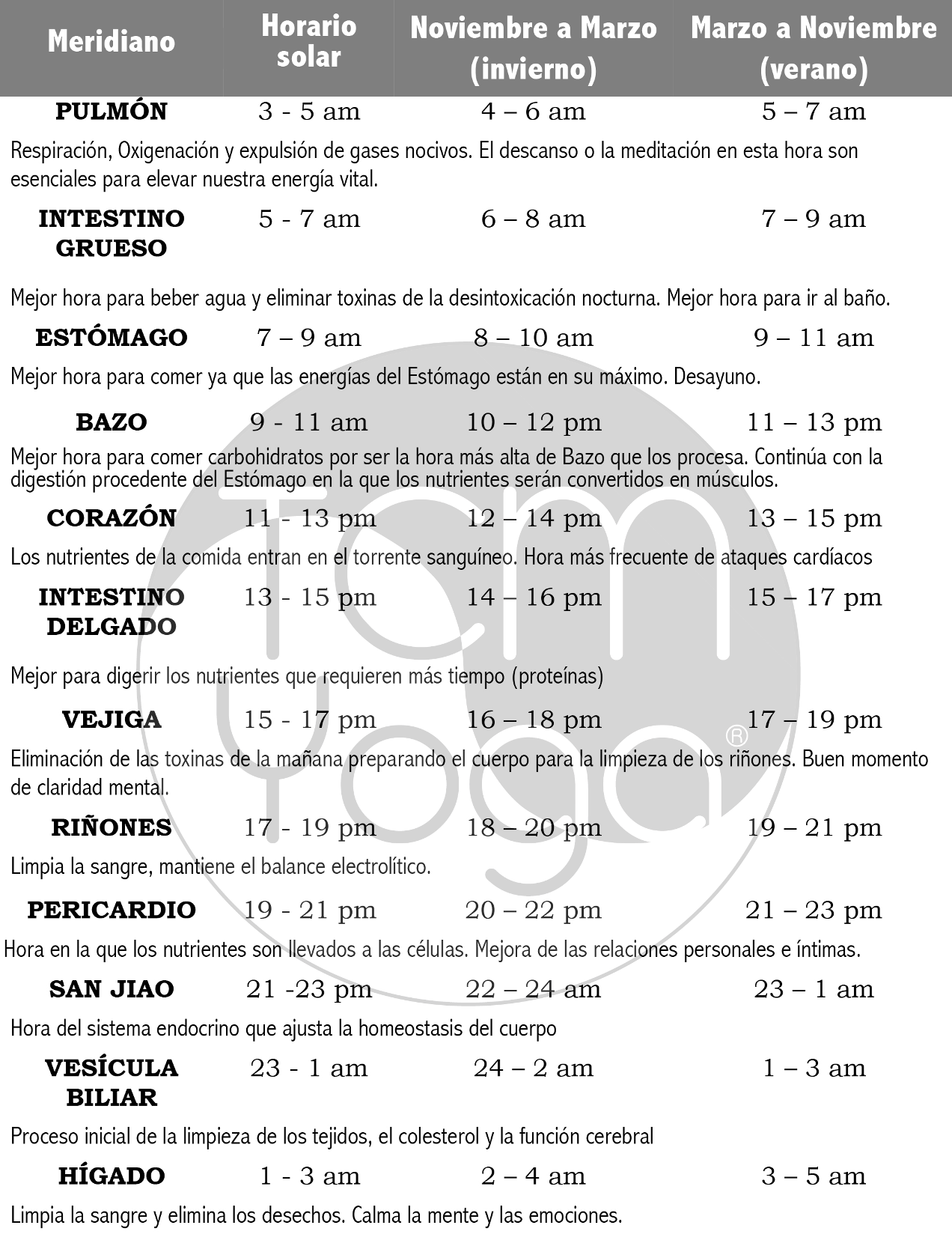
Taking into account the adjustments for phases 1 and 2, we find that the 2-hour cycle associated with each Main Meridian changes from summer to winter, occurring at Winter: 1 hour later that in the solar time and in Summer: 2 hours later as follows:
YOGA BASED ON THE CIRCADIAN RHYTHM
Now, it was time to clear up my doubt. How can I create a sequence like the one in Daniel Orlansky but adapted to different syndromes? In TCM, there is a process of differential diagnosis that helps to understand a person’s energy imbalance. It is a complex subject that requires years of study. However, I could simplify certain aspects to make it easier to apply, taking into account the tools of yoga and the main imbalances. The whole of TCM is based on and seeks to achieve energy balance, and its treatment methods aim to balance Qi, the body fluids (Jinye), Blood (Xue), Yin and Yang, the Five Elements, the Organs (Zang-Fu), etc. I then saw clearly that there were three main approaches in yoga (postural stillness without muscle tone, postural stillness with muscle tone centred on alignment, and Vinyasa or movement) and that these approaches enabled me to treat different biotypes and imbalances. Furthermore, in parallel, I had been trained in Ayurveda for over a decade and was very familiar with the Doshas, or bodily biotypes, of this traditional medical science, and how the three methods of practice in yoga related to them.
MERIDIAN CIRCLES YIN. WHO IS IT FOR AND HOW TO PRACTISE
WHO IS IT FOR?
Hydration, Freshness and Unblocking the Qi
Practising Yin Yoga brings a sense of refreshment, promotes fascial and joint hydration (in other words, it increases the body’s fluids, or Jinye) and unblocks stagnant energy (Qi).
The YIN MERIDIAN CIRCLE works by reducing EXCESSES in the Elements associated with Heat and/or Dryness and a tendency towards the sympathetic branch (the Rajasic mind in Yoga)
It is ideal for people suffering from pain and stiffness, insomnia, low energy, poor posture, a nervous and restless disposition, stress, and a tendency towards irritability and/or frustration. To maximise the benefits, these people will need to gradually increase the time they spend in each pose.
From an Ayurvedic perspective, this circle is recommended for people of the following constitution Pitta y Vata Although we should progress gradually in our practice. For Pitta, we’ll start with a gentle Vinyasa, and for Vata, we’ll begin by holding each pose for 1 minute and gradually increasing the time.
AVOID: This practice is not recommended for people with a high level of “dampness” in the body, such as fluid retention, joint stiffness, etc. (according to Ayurveda, the Kapha constitution), nor for people with significant psychological conditions such as post-traumatic stress disorder or severe depression and anxiety.
HOW TO PRACTISE
- Yin Yoga poses are held for between 2 and 5 minutes, but you can start with shorter holds if you need to
- Move in and out of each pose slowly and mindfully. Take your time

- Use whatever props and equipment you need to adapt the pose to suit you. The photos shown in the diagram are for guidance only. Pay attention to the path of the meridian and find the adaptation of the pose that makes you feel as though you are stretching it, rather than simply copying the pose in the photo.
- Perform a transitional pose or a somatic movement between each one to give your tissues time to recover and allow your mind a moment’s rest between poses.
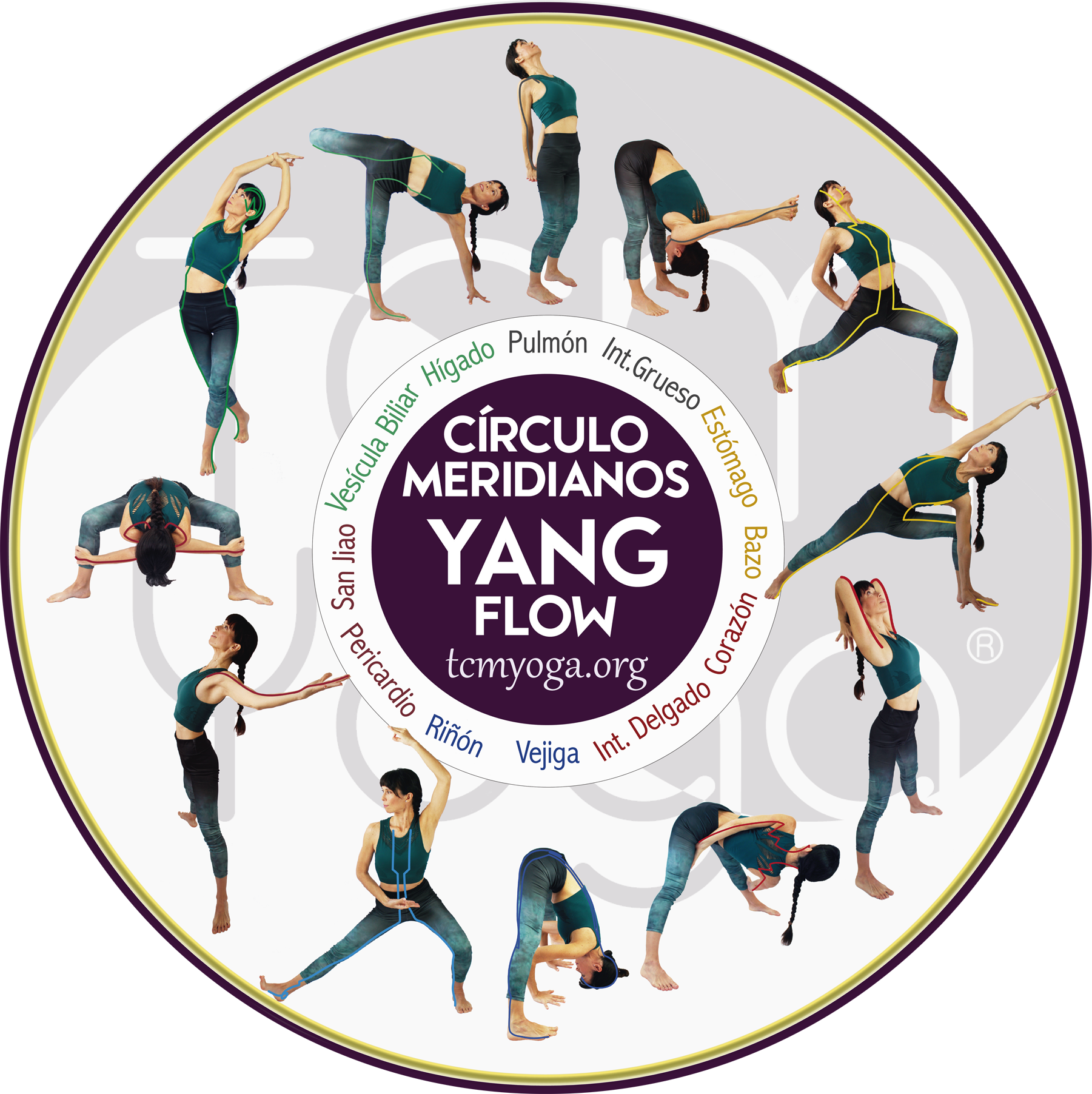
MERIDIAN CIRCLES YANG FLOW. WHO IS IT FOR AND HOW TO PRACTISE
WHO IS IT FOR?
Unblocking Qi, Dryness and Mobilising Xue (Blood)
Practising Yang Flow (Vinyasa) promotes coordination, lateral movement and proprioception. On a physiological level, it promotes the drainage of fluids, blood circulation and the mobilisation of Blood (Xue), as well as the unblocking of energy (Qi).
The YANG FLOW MERIDIAN CIRCLE works by reducing DEFICIENCIES in the Elements, which manifests as the activation of the parasympathetic branch (the Tamasic mind in yoga).
It is ideal for people who tend to feel the cold, suffer from fluid retention, lethargy, a lack of vigour and courage, low motivation, poor digestion, a heavy head, constant worry, lack of concentration, obsession, addiction, emotional blockages, etc.
From an Ayurvedic perspective, this circle is recommended for people of the following constitution Kapha which have cold humidity and little heat. Pitta You can also benefit from it, as you are prone to Qi stagnation and hot dampness, provided you finish with a calm, cooling and relaxing practice, such as a few Yin or Restorative poses.
AVOID: This practice is not recommended for people with a high level of “dryness” in the body and a tendency towards restlessness and agitation, both physical and mental. It should be avoided in cases of joint disorders (osteoarthritis, arthritis), osteoporosis or during periods of high stress (change, crisis, transitions, etc.). According to Ayurveda, the Vata constitution.
HOW TO PRACTISE
- The postures are performed as a fluid transition in time with the breath. The inhalation cycle (IN) prepares you for the posture, and the exhalation (EX) stretches the corresponding Main Meridian
- Adjust the poses to suit your body and use props when you need them. For example, you can use “bricks” in Chandra Chapasana (Liver Meridian)
- At first, the sequence won’t feel very fluid. Learn it step by step. Once you’ve got the poses down, try doing them with one breath at a time. Watch the video below, where I show you the YANG FLOW CIRCLE
MERIDIAN CIRCLES YANG CORE. WHO IS IT FOR AND HOW TO PRACTISE
WHO IS IT FOR?
Toning and Heat (Xue – Blood)
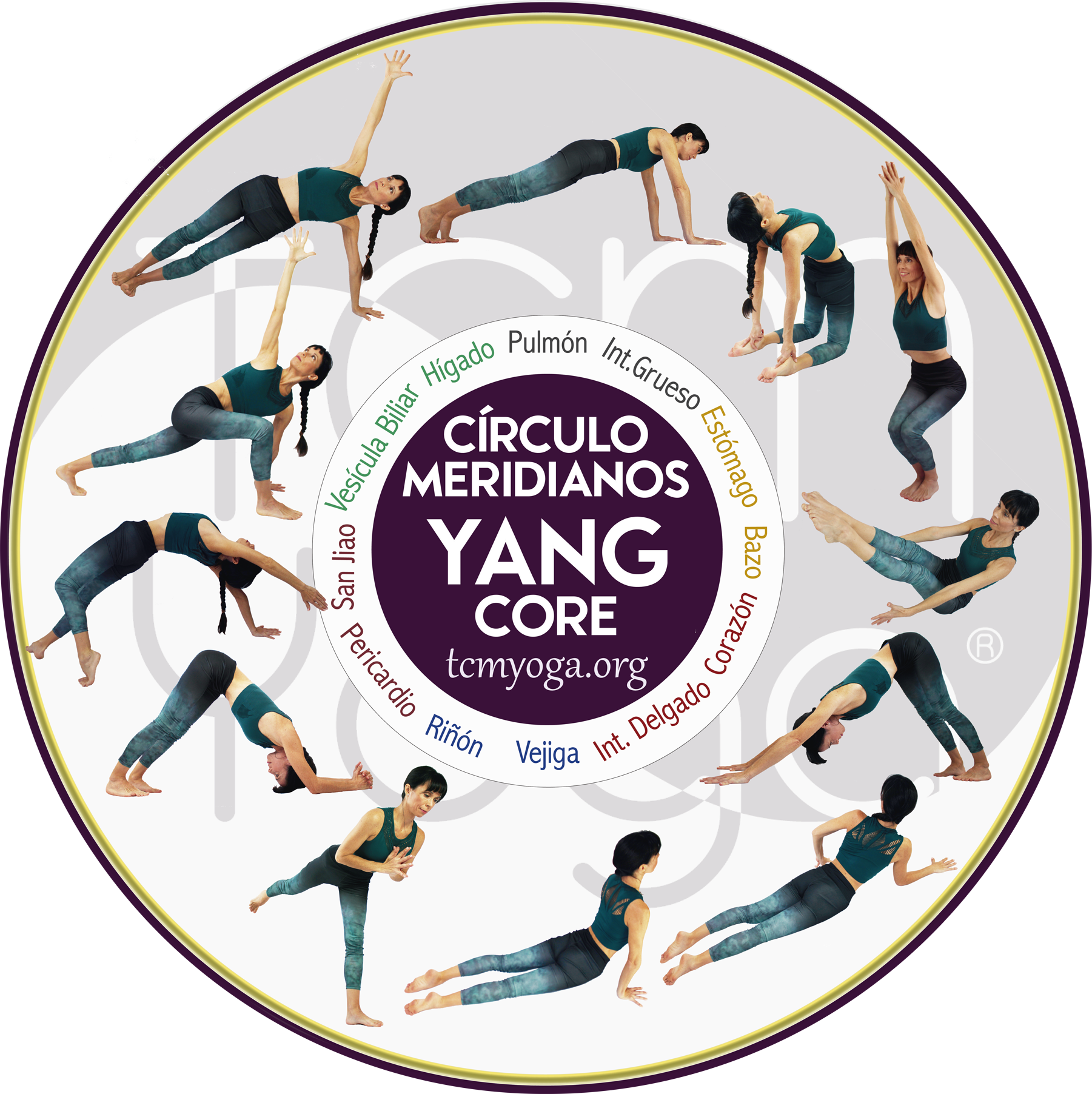
The Yang Core practice consists of static postural work focusing on muscle tone and the application of bandhas. It is inspired by styles based on postural alignment, such as Iyengar and Anusara, and requires you to hold each pose for between 3 and 10 breaths. This helps us to maximise the benefits for the myofascial system and develop biotensegrity (strength and elasticity). It supplies nutrients and blood and promotes body heat.
The YANG CORE MERIDIAN CIRCLE is useful when we have what is known in TCM as ‘mixed syndromes’, which combine EXCESSES and DEFICIENCIES in the Elements, manifesting as a dysregulation of the autonomic nervous system (Rajas and Tamas).
It is ideal for people suffering from nutrient deficiencies, low strength, lethargy, ageing, sensitivity to the cold, low energy, stress, restlessness, a lack of body awareness and mental focus, etc.
From an Ayurvedic perspective, this circle is recommended for people of the following constitution Vata to which it brings stability and warmth. Kapha You can also benefit from it, provided you start the session with a Vinyasa warm-up.
AVOID: This practice is not recommended for people with a high level of “heat”, both physical (a tendency to flush, skin irritation, sensitivity to the sun) and mental (irritability, extroversion, euphoria, etc.). According to Ayurveda, this corresponds to the Pitta constitution.
HOW TO PRACTISE
- Each pose is held for between 3 and 10 breaths.
- Move in and out of each pose slowly and mindfully. Take your time and choose the adaptation that’s right for you, with or without props.
- Perform a transitional pose or a somatic movement between each one to give your tissues time to recover and allow your mind a moment’s rest between poses.
- Finish with Savasana
These MERIDIAN CIRCLES were created under the TCMYoga® methodology, Chinese Medicine Applied to Yoga
Yoga methods and their relationship with AYURVEDA are based on the AyurYoga® HY methodology, Yoga, Ayurveda and Energy Anatomy
You can find both these training programmes and working methods within the Holistic Yoga® Advanced Programme, which offers training courses and specialisation modules covering the following subjects: www.holisticyoga.com.es
© This information is protected by copyright. If you intend to share it, please credit the author, Dr Helena Chacón, and the methodology on which it is based.