
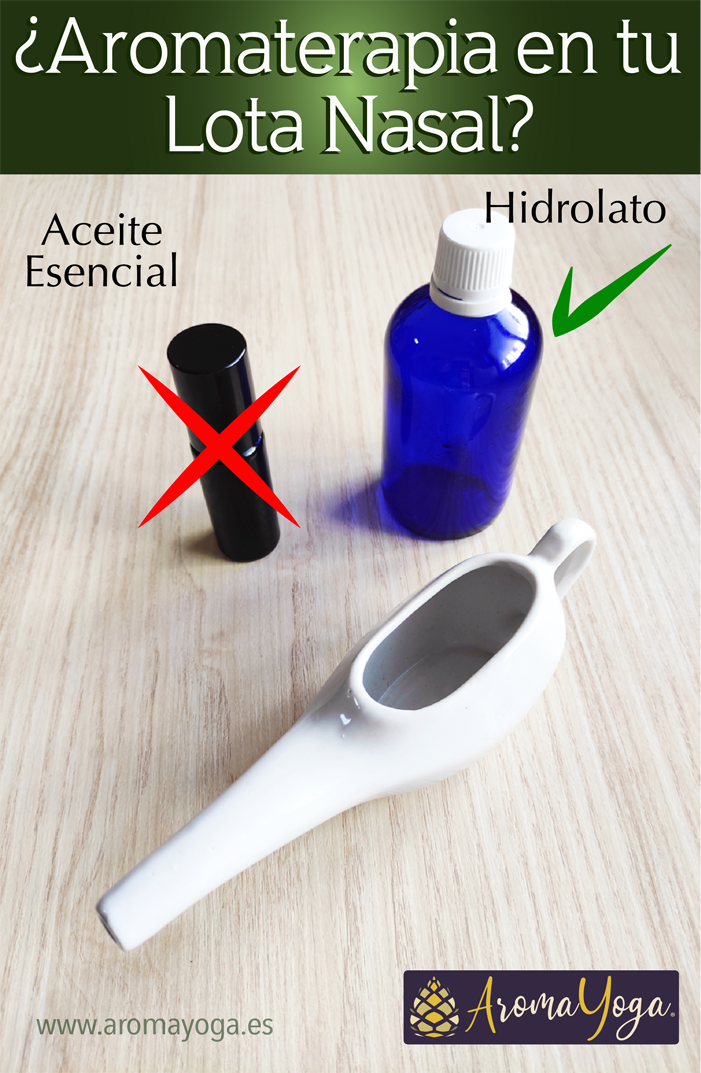
AROMATHERAPY IN YOUR NASAL POT?
Recently, I’ve seen and heard people recommending adding a few drops of essential oil to their nasal spray.  OJOOO Did you know that this can damage your mucous membranes? In this post, I’ll explain WHY YOU SHOULDN’T ADD ESSENTIAL OIL to your nasal rinse.
OJOOO Did you know that this can damage your mucous membranes? In this post, I’ll explain WHY YOU SHOULDN’T ADD ESSENTIAL OIL to your nasal rinse. Essential oils are derivatives of aromatic plants that are becoming increasingly popular. Their use and clinical application fall within the field of “aromatherapy”, the science that studies aromatic plants for medicinal purposes, with the main methods of application being olfactory and topical.
When used topically, essential oils must be diluted in a carrier oil to make them, shall we say, “biocompatible” with human skin. What might happen if you apply them directly to the skin?  Well, it depends on your skin and the essential oil. Some essential oils are dermocaustic (they burn the skin), such as cinnamon, whilst others are photosensitive (they cause skin discolouration when exposed to the sun), such as citrus oils. Furthermore, others are allergens, such as laurel oil, meaning you may develop some form of “sensitivity” or “allergy”. For this reason, you must dilute them in an oil-based carrier (not in water, as they are NOT WATER-SOLUBLE). If you do not dilute your essential oils, you may experience reactions such as skin irritation, inflammation, etc. (and this is not a “detox reaction”… it simply means that the oil has burnt and damaged your skin).
Well, it depends on your skin and the essential oil. Some essential oils are dermocaustic (they burn the skin), such as cinnamon, whilst others are photosensitive (they cause skin discolouration when exposed to the sun), such as citrus oils. Furthermore, others are allergens, such as laurel oil, meaning you may develop some form of “sensitivity” or “allergy”. For this reason, you must dilute them in an oil-based carrier (not in water, as they are NOT WATER-SOLUBLE). If you do not dilute your essential oils, you may experience reactions such as skin irritation, inflammation, etc. (and this is not a “detox reaction”… it simply means that the oil has burnt and damaged your skin).But… you’ve probably heard that some essential oils can be applied directly to the skin. Let’s clarify this a little. It’s true that some essential oils, such as eucalyptus or pine, can be applied directly. Just 1 or 2 drops (not a whole stream of drops) on the palms of your hands or your chest. But this isn’t entirely safe if we don’t know exactly what your skin is like or if it’s particularly sensitive… so… why take the risk?
Let’s now talk about NASAL RINSES. “Jala Neti” is a yogic practice that uses lukewarm, slightly salted water to cleanse the nasal passages. If we add essential oils, in this case, we’re not talking about applying them to the skin, but to the mucous membranes, which are even more delicate. So, as we’ve already mentioned that essential oils DO NOT DILUTE IN WATER, any essential oil you add to your nasal pot will remain as tiny droplets floating in the water (no matter how much you stir, they won’t dilute) and, as they pass over your mucous membranes, they may damage them. Under no circumstances should you ever apply “undiluted essential oil” to your mucous membranes.
Some people have also said to me… “But I’ve heard that Ayurveda involves applying essential oils to the nasal passages.” Let’s see… let’s explain this. Ayurveda has a technique called Nasya in which you instil a “medicated oil”. This medicated oil is a hot infusion made from aromatic plants. So, what you’re actually applying is infused vegetable oil (not essential oils). Some modern forms of “Nasya” also add essential oil to the product, but as it is an oily (not aqueous) product, the amount of essential oil is very small and it should be applied by an Ayurvedic practitioner who will know your Dosha (biotype), your imbalance (Vikruti) and the specific treatment for you.
Would you like to use AROMATHERAPY in your NASAL POT? If so, use hydrosols, which are the water-soluble by-product of distillation. These are diluted in water and generally have far fewer contraindications. You can use a few drops of lavender or chamomile hydrosol, which are very soothing, or my personal favourite, myrtle. But be careful – use only a very small amount… in this case, more isn’t better.
 REMEMBER
 Just because a product is NATURAL does not mean that it is HARMLESS or has no CONTRAINDICATIONS Not all the information circulating on the internet has been verified or is reliable Just because it doesn’t trigger any REACTION in you doesn’t mean it’s a safe practice. Do not recommend treatments based on ESSENTIAL OILS unless you have a basic qualification as an AROMATHERAPIST Just because someone sells ESSENTIAL OILS doesn’t mean they know anything about AROMATHERAPY, for the same reason that a car salesman doesn’t necessarily know anything about engineering