THE ORIGINS AND EVOLUTION OF YIN YOGA
WHAT IS YIN YOGA AND WHY IS IT SO POPULAR?
Yin Yoga It is a term used today to describe a static form of yoga, in which postures are held for long periods to improve the fascial tissue, an attitude of mindfulness is cultivated, and the practice is rooted in Traditional Chinese Medicine and Taoist philosophy. Unlike the Restorative Yoga with the support that he popularised B.K.S. Iyengar and whose characteristics are stillness and relaxation, the practice of Yin Yoga He does not usually use any supports, so maintaining these postures and relaxing into them involves a certain degree of difficulty and readjustment to his comfort zone.

Nowadays, the practice of Yin Yoga It is spreading rapidly across the world for a number of reasons:
1) It offers many benefits for physical and mental health (it improves flexibility, physical and energetic circulation, and joint mobility; it promotes mindfulness, etc.).
2) It is a practice that most participants can take part in, as the postures are performed on the floor, with variations and adaptations available for each individual.
3) The practice of Yin Yoga It offers time, tranquillity, calm and meditation – qualities that are highly sought after in a society characterised by stress and anxiety.
4) The growing popularity of Yang-style forms, which emphasise movement and strength (Ashtanga, Rocket, Power, etc.) has led to a polarisation in our practice of Hatha Yoga. After all, “Hatha” means “Sun” and “Moon”, or, in other words, “Yang” and “Yin”. When we spend a lot of time practising a Yang style, we will probably need to do some Yin practice to balance things out and find equilibrium.
IS YIN YOGA A MODERN PRACTICE?
The term Yin Yoga It is associated with several contemporary yoga and kung fu teachers. However, this way of practising – centred on stillness, observation and adapting to new levels and limits – is a practice as ancient as yoga itself.
The history of yoga is long and complex. The earliest ancient texts to refer to this term (Vedas, Patanjali’s Yoga Sutras, etc.) did not refer to physical postures but rather understood yoga as the union of the individual with the divine (Vedanta) or calm amidst the fluctuations of the mind (Patanjali). Subsequently, the postures (asanas) described in the texts are presented with the aim of keeping the body healthy and supple in order to facilitate meditation and ensure that the physical body does not act as an obstacle to it. In the Hatha Yoga Pradipika Where more than a dozen asanas are described, one begins to observe some postures of a Yang (Kukutasana) and others of a Yin (Gomukhasana). Over the centuries, other texts have appeared describing an ever-increasing number of asanas (Gheranda Samhita, Shiva Samhita). In the 20th century, the man known as the father of modern yoga, Krishnamacharya He claims to know at least 3,000 yoga postures, and his disciples have derived a large proportion of modern yoga styles, mainly with a tendency towards Yang (dynamism, strength and warmth).
In other words, over time, the meaning of yoga – understood as “union” and as “calm” (Yin-Yang) seems to have gradually been replaced by vigour and strength (Yang). This is neither necessarily good nor bad; what matters here is the search for balance. Each style has its own advantages and benefits. Wisdom arises when we realise what we need at a given moment in our lives. And here, the ancient static practice based on stillness re-emerges and flourishes once more to meet the needs of those yogis and yoginis who feel they have become polarised towards the Yang whether because of their lifestyle or their yoga practice.
THE INFLUENCE OF MONKEYS
There are several well-known teachers who have popularised the practice of Yin Yoga what they are like Paulie Zink, Paul Grilley y Sarah Powers.
Paulie Zink He was a Kung Fu practitioner with an extraordinary level of flexibility. After practising various martial arts, he became a disciple and successor of a style known as Tai Shing Men developed in the 19th century by a prison inmate, based on the movements of the monkeys he could see from his cell. Over time Paulie He developed his own style, which he taught in his garage and which he called Taoist Yoga with a more active form (Yang), a more static form (Yin) and movements based on the Five Elements. Taoist Yoga It was a term that had already been used in the 1970s and 1980s by some Qigong teachers (such as Lu K’uan Yu’s o Mantak Chia) to promote its practice.
PHYSICAL AND ENERGETIC ANATOMY
One of the pupils at Paulie Zink which really popularised the Taoist Yoga He was a yoga teacher called Paul Grilley who was struck by the astonishing flexibility of Paullie. Paul Grilley He was a teacher of Ashtanga y Bikram and had a thorough knowledge of anatomy. After meeting Paullie began to adopt a more Yin where he held the poses for long periods and began to notice their benefits. In 1990 Paul met the Dr Motoyama, a renowned researcher and writer with extensive knowledge of yoga and traditional Chinese medicine. Paul He learnt about energy anatomy (Chinese meridians, chakras) from him, which, combined with his knowledge of structural anatomy and Taoist yoga as passed down by Paullie laid a solid foundation for the practice of Yin Yoga.
BUDDHIST MEDITATION
Sarah Powers She was a psychologist with a strong desire to explore the human mind, which led her to take up yoga. One day, Sarah, trainee at Ashtanga attended a class in Yin Yoga taught by Paul. At this moment Paul It offers no explanation of the many benefits of the practice or its influence on our physical and energetic anatomy, so that class remained just another anecdote in the life of Sarah. Years later, Sarah decided to go on a meditation retreat Vipassana 10 days. During this time, this yogini discovered that despite having practised for years Ashtanga Yoga, she found it very difficult to sit in a meditative posture for several hours. Later on, he crossed paths with her again Paul, who explained to him the benefits and importance of such a practice Yin combined with Yang to keep tissues and joints healthy and to aid meditation. Sarah He devoted himself body and soul to learning and then to passing on his knowledge. He began teaching classes and intensive courses in a particular style Yang such as Yin. In addition to knowledge of the anatomy of Paul, Sarah He shares his insights into spiritual psychology and his knowledge of mindfulness.
TRADITIONAL CHINESE MEDICINE (TCM YOGA). PERSONAL CONTRIBUTION
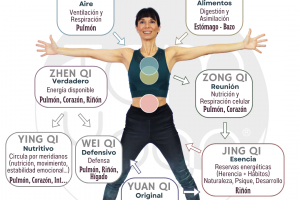
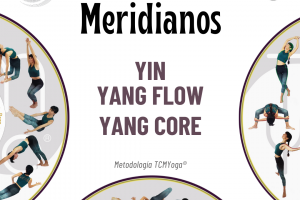
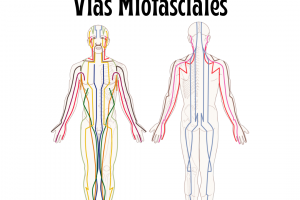
To conclude this article, I would like to share my humble perspective and experience. After several years spent practising and teaching yoga, as well as learning and applying various therapeutic tools, I decided to integrate the concepts of Traditional Chinese Medicine into a form of yoga known as TCM Yoga. The contributions of Paul Grilley y Sarah Powers played a key role in laying the foundations for the component Yin. The great work of people such as Myer Mapping out the course of the myofascial tracts has been particularly useful for the creation of Myofascial Yoga® (classes on meridians, myofascial release using balls, etc.) and their striking similarity to the Chinese meridians further highlighted the importance of fascia and its influence on TCM Yoga. My studies in Traditional Chinese Medicine were essential in helping me to develop a practice that took into account the concepts of Yin and Yang, Jing and Xue, the Five Chinese Elements (in both deficiency and excess), the Zang-Fu organs, the meridians and the acupuncture points.
TCM Yoga It was developed as part of an even broader concept: the development of a holistic therapeutic yoga method in which we do not treat the condition as a “label”, but rather the person experiencing it, taking into account their physical, emotional, mental and spiritual circumstances. Holistic Yoga Therapy®, was founded in 2014 with the aim of integrating knowledge of Myer’s Myofascial Meridians, Ayurveda, Thai massage and Chinese medicine. The result today is a comprehensive training programme comprising courses in Myofascial Yoga®, AyurYoga®, TCM Yoga® and final-year specialisation courses in Holistic Yoga Therapy.
If you’d like to find out more about how holistic health and yoga can go hand in hand, visit our websites:
Adapted text from Bernie Clark’s book “The Complete Guide to Yin Yoga” and other authors for the comprehensive TCMYoga® YIN YOGA training course, [number] hours.
Dr Helena Chacón Muñoz