VAJRASANA. EFFECTS ON ENERGY CHANNELS AND POINTS
INTRODUCTION
Vajrasana, or the Diamond Pose, is a pose widely used in yoga and other spiritual disciplines such as Zen Buddhism and Islam. This pose is mentioned in classical texts such as the Hatha Yoga Pradipika and is the only one recommended after a meal, as it aids digestion.
When we sit on our heels, we are stretching the front of our legs – that is, the Superficial Anterior Myofascial Chain (LAS), which comprises the rectus abdominis, quadriceps and tibialis anterior. But what do these muscles and fascia have to do with digestion?
We find the answer when we look into Eastern medicine: Traditional Chinese Medicine (TCM), Ayurveda and Thai medicine.
TCM or TCM
In a similar way to the LAS Myofascial Pathway, when we sit in Vajrasana we are stretching the Chinese Stomach and Spleen meridians, which play an essential role in the digestive process. Within the Stomach meridian lies the E41 acupuncture point, known as Jiexi, which means “dispersing current”. This point is essential for releasing heat from this meridian and therefore alleviates symptoms of heat in the stomach (voracious hunger, heartburn, belching, heaviness, bloating, etc.), in the upper body (headache, red face and eyes, vertigo, high blood pressure, etc.) and relieves localised pain in the foot (sprains, oedema, etc.). Furthermore, as it is an Earth element point that releases heat, it reduces emotional excesses associated with that element, such as obstinacy, addiction, psychosis, mania, agitation, etc.
AYURVEDA
In Ayurveda and the spiritual tradition of India, the “Visvodhara” nadi is described as being located on the front of the leg; according to according to David Frawley, on Samana Vayu, Pachaka Pitta and Kledaka Kapha (sub-doshas involved in digestion). At the front of the ankle joint, Vasant D. Lad describes the marma point Pada Charana, whose therapeutic action is similar to that of the Chinese point E41, although this author also notes a significant influence on the bladder and colon.
THAI
Similar to the Chinese meridians and Ayurvedic nadis, the Thai sens also describe energy pathways. Specifically, Sahatsarangsi (on the left side) and Thawari (on the right) run along the front of the face, chest and legs, just as the LAS Myofascial Pathway, the Stomach meridian and the Visvodhara nadi do.
MYOFASCIAL YOGA, MARMA YOGA AND ACU YOGA
For many years, we have been committed to a holistic and comprehensive approach to yoga and yoga therapy that encompasses fascia, Ayurveda and Chinese medicine, from which “Holistic Yoga Therapy®” was born.
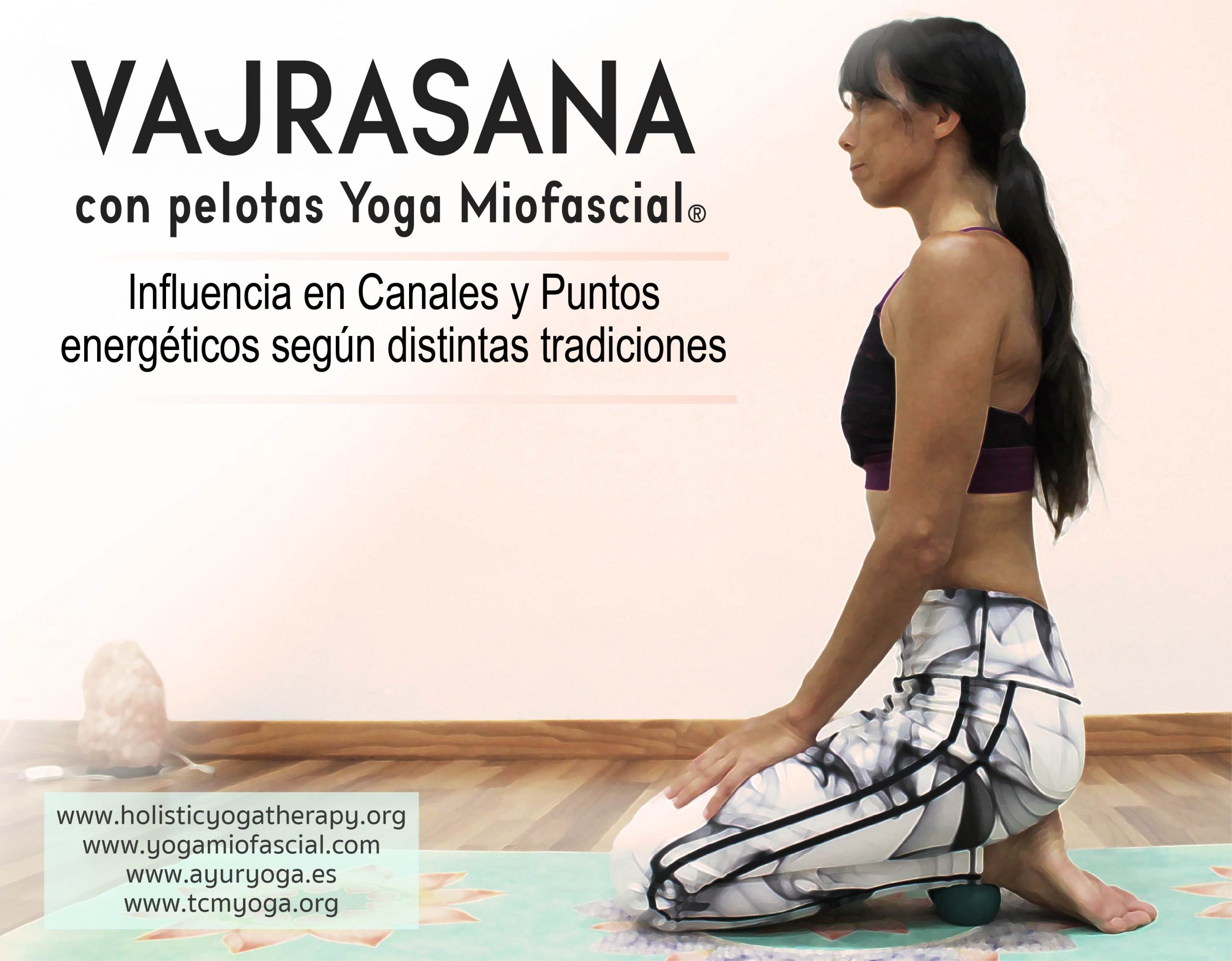
* In the picture, you can see a couple of balls Myofascial Yoga® placed on the ankle joint (acupuncture point E41 – Marma Pada Charana) whilst performing Vajrasana. This pressure helps to release the fasciae associated with the point – namely, the Anterior LAS Meridian – thereby improving circulation in the foot, reducing inflammation, enhancing mobility, etc.
Furthermore, by drawing on the holistic approach of Eastern medicine, we understand that we not only experience benefits in the joints of the foot but also in other parts of the body, as well as changes in our emotional state.
* In AyurYoga®, this marma has a significant influence on Samana Vayu, regulating bowel and stomach movements, and also plays an important role in Apana Vayu, our downward-moving energy, regulating the passage of stools and urine. We can work on it by supplying energy when it is deficient (e.g. in Tadasana by raising the toes) or by releasing it when it is in excess (e.g. in Vajrasana or by stretching the feet and pointing the toes). Incorporating knowledge of the marmas into our yoga practice (Marma Yoga) opens up a profound and subtle yet powerful world, offering a wide variety of therapeutic tools for ourselves and our students.
* Similarly, applying the profound knowledge of Chinese medicine to yoga (TCMYoga®) allows us to broaden our understanding of the asana itself. In Yin Yoga, a yoga discipline with Taoist roots, Vajrasana is described as an important posture for stretching the Earth meridians. Holding the posture for several minutes promotes proper energy flow in this meridian. Furthermore, by applying pressure to certain Earth acupoints (Acu Yoga) using Yoga Myofascial® balls, we can enhance the benefits which, from the perspective of Chinese medicine, will include:
– Local improvement in joint function
– Soothes the digestive system when it is upset
– Reduces heat in the upper body
– It calms emotional states associated with agitation, mania and obsession.
In this way, applying pressure with a ball to certain areas of the body during a yoga class enables us to improve the fascial tissue and enhance energy flow, benefiting not only the specific area but also distal areas, as well as bringing about changes in our emotional and mental patterns. Would you like to give it a go?
If you found this interesting, please help us spread the word by sharing it. Thank you
If you’d like to train in any of the disciplines mentioned above, you can do so by visiting their respective websites:
If you prefer, you can send us an email at info@yogakula.es and we’d be delighted to provide you with information about our blended and online courses and training programmes.