MYOFASCIAL RELEASE – WHAT IS IT?
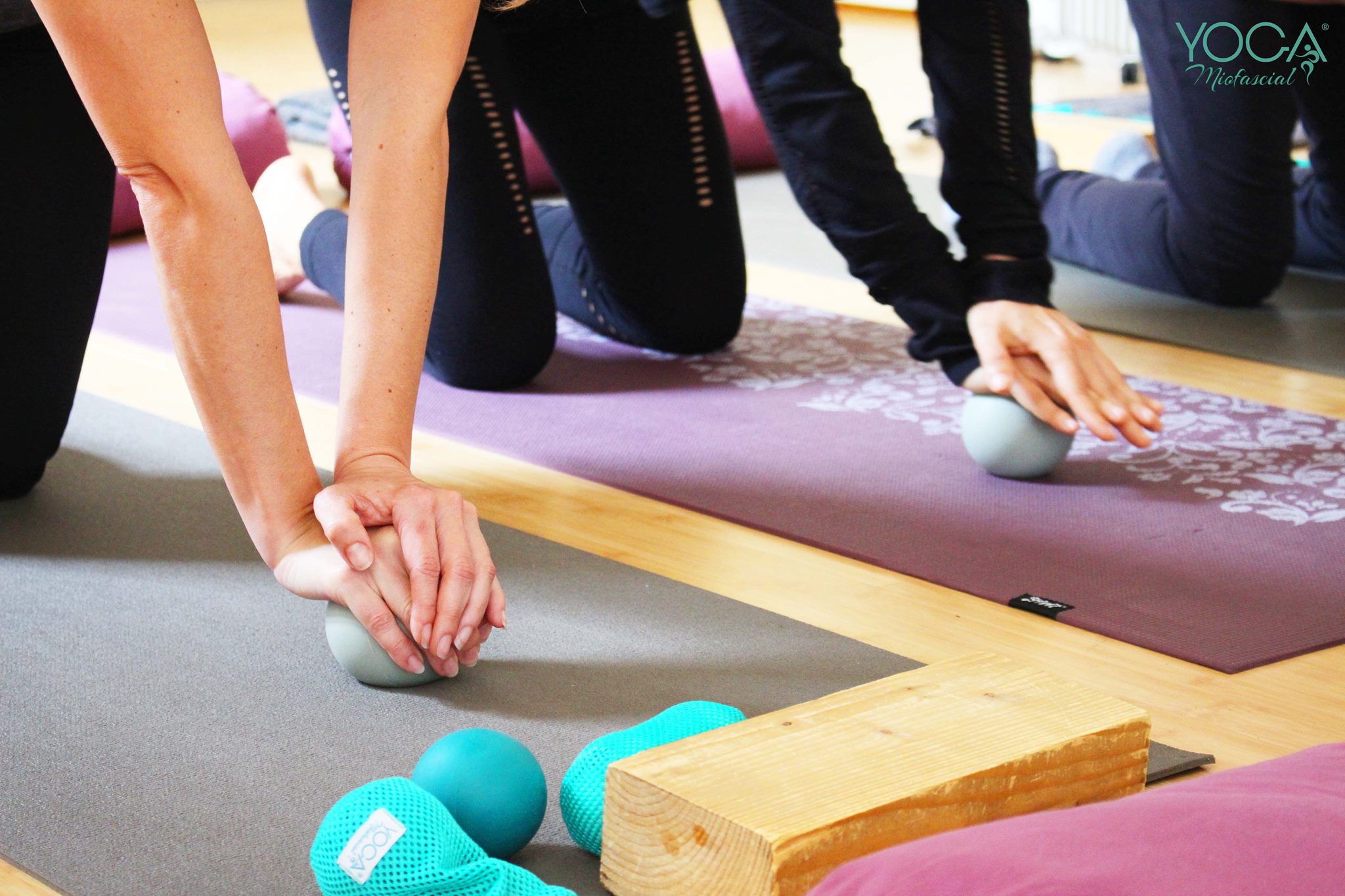
Our fascial tissue is adversely affected both when we use it incorrectly and when we keep it passive and immobile. This “poor condition” has led to the development of various tools that facilitate myofascial release, such as self-massage using Myofascial Yoga® balls.
DEFINITION:
“Myofascial Release” is a concept that refers to the process of improving the condition of our fascia (a three-dimensional network of connective tissue that connects everything) through movement, coordination and pain relief. This tissue is particularly sensitive to physical and psychological changes, as it contains many sensory receptors. If our fasciae are not healthy, they can become tense, tear, form adhesions, weaken, dry out, etc., thereby affecting our posture and our mental well-being.
TRIGGER POINTS:
Many people suffer from pain points known in physiotherapy as trigger points. These are recognised as tender points made up of soft tissue, the pain in which is relieved by pressure, massage, stretching or dry needling.
RELATIONSHIP WITH EASTERN MEDICINES (AYURVEDA, TCM):
“Hartmut Heine” and “Dosher” are researchers who have highlighted the striking similarity between trigger points and acupuncture points in Traditional Chinese Medicine (TCM). In their view, and that of many other authors, it is fair to recognise that current treatments for myofascial pain represent an independent rediscovery of the healing principles of this ancient Chinese medical science. In Ayurveda (Indian medicine), these points are also recognised as marmas.
SYMPTOMS AND CAUSES:
These areas of the body are where the body’s fascial tissue has thickened, torn or become inflamed, etc., causing pain and tension which, in turn, restrict the range of motion of the surrounding muscles, leading to changes in posture over time. Trigger points are caused by: impacts (trauma), repetitive or sudden movements, poor postural habits, insufficient rest between training sessions, poor nutrition and lack of hydration, emotional disturbances, etc. Sensitivity at trigger points can manifest as pain, tingling, tremors, a sensation of cold or heat… Ultimately, this is the result of the “stress” to which the fascia has been subjected. Sourojit Bhowmick demonstrated that when the sympathetic nervous system (stress) is stimulated, an immune system response is triggered which secretes TGF-beta-1. TGF-beta-1 has been shown to be one of the most potent stimulators of the fascia, promoting its contraction and stiffness.
MYOFASCIAL RELEASE TOOLS:
There are several ways to work on the myofascial tissue to reverse this process of stiffness. Some of these are closely linked either to massage or self-massage (Rolfing, the Bowen Technique, Osteopathy, Craniosacral Therapy, Myofascial Release using balls, etc.) or with the modification of postural habits (Myofascial Yoga with its practice of active and passive asanas and Thai manipulations, Yin Yoga, etc.). Current scientific research is still investigating the exact mechanisms by which a person feels better following myofascial release work. Robert Schleip explains in his article “Fascia as a Sensory Organ” that the short-term mechanisms of fascial deformation are not influenced by the “thixotropy” or “piezoelectricity” of this tissue, but rather by the active contribution of the central nervous system and mechanoreceptors. In fact, it has been discovered that when we let our body fall onto a ball, mechanoreceptors are triggered, leading to the activation of the parasympathetic nervous system (the relaxation response). As a result, myofascial release using balls produces:
* Increased elasticity
* Improved blood circulation
* Relief from tension and pain
* Recovery from muscle fatigue
* Reduction in inflammation
* Restoring vital energy
* Improved movement and coordination
* Greater fluidity and smoothness in the asanas
* Body awareness
* An improvement in your mood
* Promotes relaxation and deep sleep
Interesting!! Isn't it?
Please, if you’ve got this far and think this might be of interest to anyone else, do share it so we can reach more people  🙂
🙂
www.helenachacon.com
www.tcmyoga.org
www.holisticyogatherapy.org
www.yogamiofascial.com
www.ayuryoga.es
Tag:fascia, fascial, fascias, fascia and yoga, holisticyogatherapy, myofascial release, myofascial, myer, tcmyoga, yinyoga, yogafascial, yogafascias, yogakula, yoga and traditional Chinese medicine, myofascial yoga, yogaonline, personalised yoga, yogasalud, therapeutic yoga, yoga therapy, yoga and fascia