SPANDA AND THE FIVE ELEMENTS
The Sanskrit word “Spanda” is derived from the root “spadi”, which means “to move slightly” (kimcit calana). By this, we refer to the constant pulsation or vibration throughout the Universe, from the smallest to the largest. It refers to the continuous cyclical flow, similar to our breathing, which is punctuated by the rhythm of inhalation and exhalation. We live within a subtle, ever-changing energy network where everything is either in a state of expansion or contraction, where opposites “dance” and influence one another – the basis of Taoism with its well-known concepts of Yin and Yang. Through the practice of yoga, we develop self-awareness and inner transformation so as not to remain stuck in pre-established patterns, and to understand that everything is pure pulsation. An understanding of Spanda helps us to discern the “wave” or ‘vibration’ that is most suited to us, greatly enriching our practice and our lives.
In our yoga practice, it is important to learn to flow with our expansive and contractive states in order to move towards balance. When we set out to practise a Hatha Yoga session, there are many movements, forms and postures we can choose from. Our predominance of one or more elements (which in Ayurveda we understand as Dosha) will guide our “Spanda” – our pulse, our vibration and our way of practising.
That said, we must learn to practise by balancing our impulses and engaging in those practices that, at first glance, seem most difficult to us, in order to incorporate the elements that are in short supply within us. Thus, if, for example, someone of the Kapha constitution (who has an excess of Earth and Water) allows themselves to be carried along by their inertia and tendency towards stillness, they will fail to incorporate the elements they need most (Fire, Air and Ether).
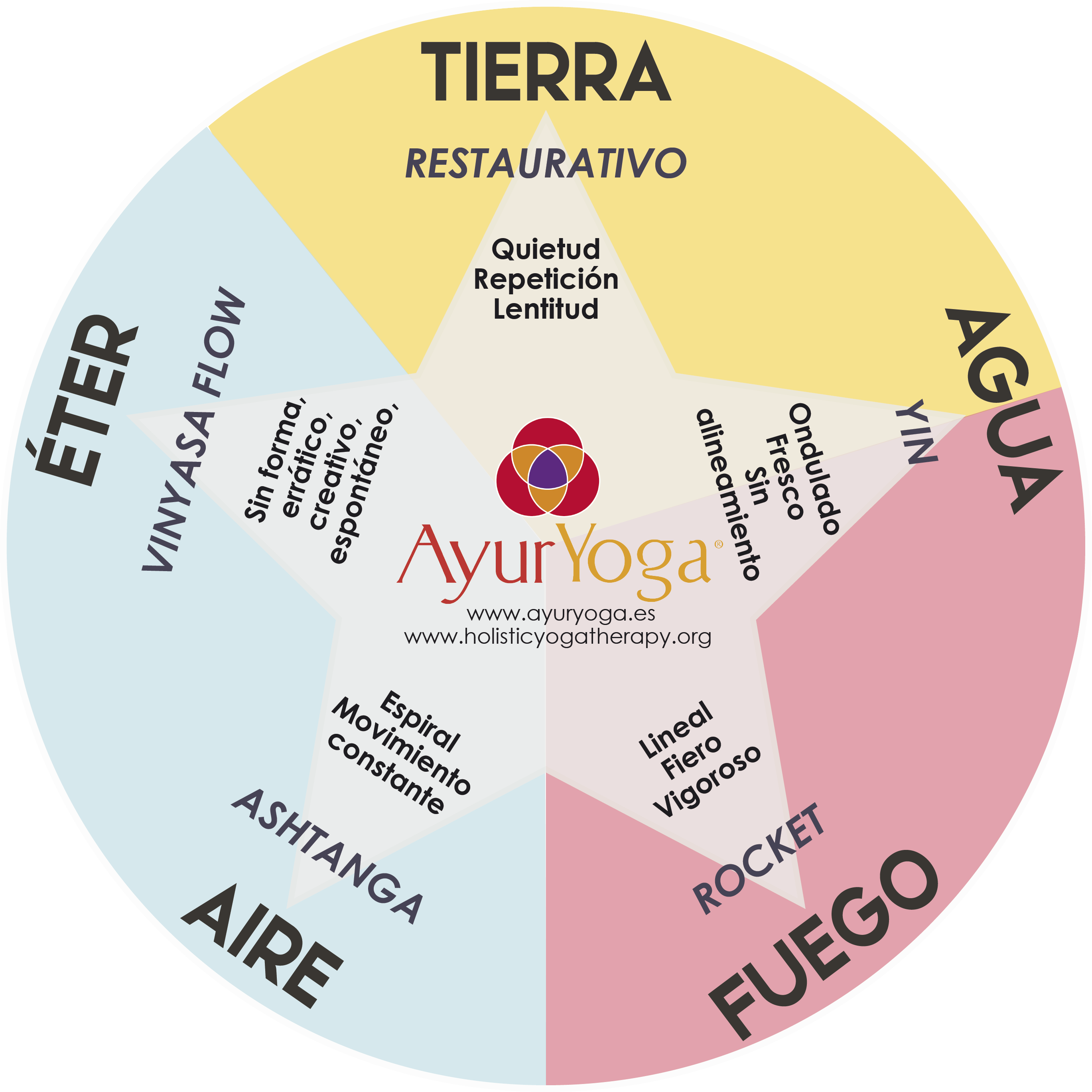
Below are some of the qualities that each Element brings to the mat. In the image, you can also see an example of a style of yoga associated with that element. Furthermore, bearing this in mind, we can understand what the balanced practice will be for the DOSHAS (Ayurvedic biotypes) according to the AyurYoga® methodology.
EARTH: Stillness, repetition, slowness
WATER: Wavy, cool, not aligned
FIRE: Linear, fierce, vigorous movement
AIR: Spiral movements, constant
ÉTER: Formless, erratic, creative, spontaneous movements
VATA (Air and Ether). They tend to move excessively and without a set routine. The best practices are those that build strength through muscle and core alignment (Fire) and styles focused on stillness and relaxation, such as Yin and Restorative (Water, Earth).
PITTA (Fire and Water). They tend to be very competitive and energetic in their practice. They need flowing practices such as Vinyasa Flow (Ether) or Ashtanga Vinyasa (Air), combined with more static practices such as Restorative (Earth)
KAPHA (Earth and Water). They tend to settle into a routine and let themselves be overcome by laziness. They need vigorous and challenging practices that build muscle strength, such as Rocket (Fire), as well as practices that encourage both steady movement, e.g. Ashtanga Vinyasa (Air), and erratic movement, e.g. Vinyasa Flow (Ether).
Written by: Dr Helena Chacón
If you enjoyed this post, please help us by sharing it 🙂
If you’d like to train in AyurYoga®, you can do so either online or via a blended learning programme. CONTACT US:
www.ayuryoga.es